Le Bocal & la Botte
Organic grocer
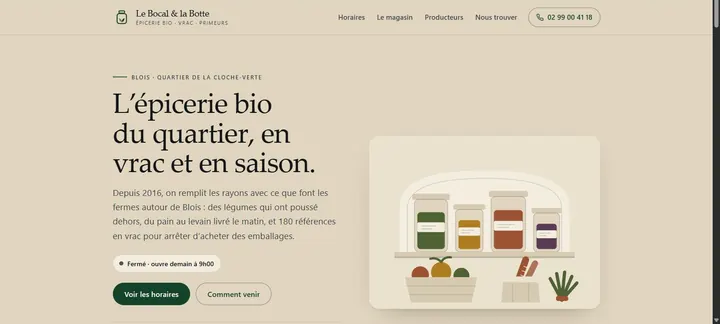
Paper background, a serif with character, no photography at all: everything is drawn. The plain register, for a shop with no good pictures to hand.
Open the siteYour opening hours, your address, what you sell, real photographs of the place: what somebody looks for on a Sunday evening before coming over. We build it, we put it online, and we handle the domain name, the hosting and the changes. Whether you are starting from nothing or from a site built in 2016.
Three demonstration sites, in three different worlds. The businesses are made up: these are samples of work, not clients. Click through, the pages open in full.
Organic grocer
Paper background, a serif with character, no photography at all: everything is drawn. The plain register, for a shop with no good pictures to hand.
Open the site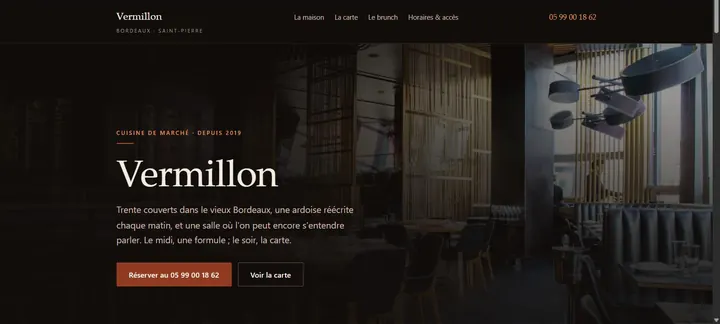
Restaurant
Dark and warm, full-width photography, the menu and service hours before anything else. The register where the image is the product.
Open the site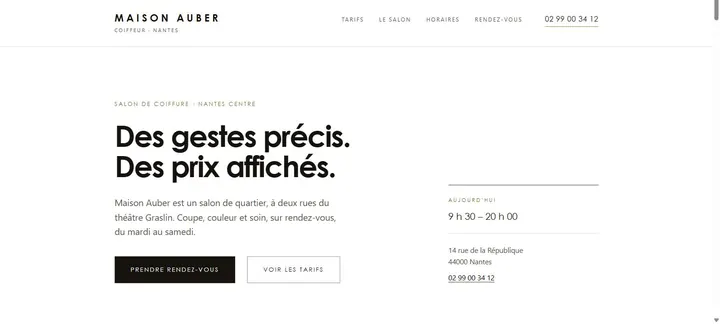
Hair salon
Plenty of white, sharp contrast, services and prices shown straight away. The register where the empty space makes the style.
Open the siteA shop website does not need to be big. It needs to be right. Most visits last less than a minute: somebody is looking for one precise thing, they find it or they do not, and they leave.
Here is what goes in by default, and that is already the essentials:
Plenty of shops get by with a Google listing and a Facebook page nobody has touched in two years. That holds up until somebody looks. The trouble comes on a Sunday evening, when somebody wants to check tomorrow's hours or read the menu before booking: they find nothing, and they go elsewhere.
We design the site, we put it online, and we handle the domain name and the hosting. The name is registered in yours: it belongs to you, it renews every year, and it follows you if one day you work with somebody else. It is the first thing we check, because it is what most often traps a shop that wants to move.
This is the simplest case to deal with, and yet the one people put off the longest. A site built by a friend in 2016 and never touched since: the text is tiny on a phone, the hours shown are last year’s, and nobody knows who holds the domain name any more.
The real fault, almost always, is that it does not work on mobile - and that is where your customers look at it. We start from what exists rather than throwing it all out: we keep what works, we redo the layout for the phone, we correct the wrong information. A redesign does not mean starting over.
That is the question to settle before all the others, and the answer is not the same from one shop to the next.
A wine merchant wants the site to exist, to be right, and never to be mentioned again: they will open it twice a year to check their hours. A restaurant owner writes on 2 August because they close on the 10th and nothing says so anywhere: what they are buying is somebody to send three lines to. A bakery wants its loyalty card and its reviews to live inside its own pages, because its customers already have the card on their phone.
The quote then states in plain words who does what: publishing, hosting, backups, the security certificate, and the changes of a trading year.
A website builder does not know your shop: it sells you a template, and it is up to you to plug your loyalty scheme and your reviews into it. Find the module, configure it, then check in six months that it still works.
That is the difference: we are already with you for your loyalty programme. So the site can carry the card your customers add to their phone and the reviews you collect at the counter, without you having to deal with any of it. One person to contact, and somebody who knows what you sell when you write to them.
Nobody can guarantee you first place on Google, and be wary of anyone who promises it. A well-built site makes you findable in your neighbourhood and on what you sell, which is already what matters for a local shop.
Fidzi is run at a human scale: there is no call centre open through the night. In exchange, whoever answers knows your shop and has seen it. We work around Angers and around Bordeaux, and in those two areas we can come back.
Nothing starts before you have a clear quote in front of you.
That depends mostly on you: the long part is not building the pages, it is gathering the text and the photographs. A three or four page site whose content is ready goes online within a few days. The timeframe is on the quote, and it accounts for what is still to be gathered on your side.
Yes if you want to, no if you do not - that is exactly the question we settle at the start. Sending three lines is often simpler than opening a tool nobody has touched in six months, and that is a perfectly sound choice. It is written into the quote, not decided afterwards.
You do. It is registered in your name, not ours, and that is not negotiable. It is what most often traps a shop that wants to change supplier: the domain belongs to somebody who no longer answers, and everything has to start again. If your domain already exists, we check who holds it before anything else.
We first look at whether it is worth taking over. Often it is: the text is good, so are the photographs, only the layout has aged and does not hold up on a phone. Taking over costs less than rebuilding, and you do not lose the search ranking the site has earned over the years.
We look at it, we tell you what is missing, and we tie it to the site: the hours must match on both sides, otherwise Google shows its own. The listing stays yours and is managed from your account - we do not ask to take it over.
Around Angers and around Bordeaux, where we can come to your shop, see the place and come back later. The work itself is done remotely, so elsewhere in France is possible - but without the visit, and we say so plainly before starting.